The Agent Selection Matrix: Choosing Between Claude Opus 5.5, Gemini 3.1 Pro, Codex, and Grok
What happens when you pit the world top five frontier agentic models against one another in a nine-hour, 75-agent stress test consuming over one billion tokens of research? You discover that general-purpose intelligence does not translate into general-purpose agentic execution. In specialized agent workflows, picking the wrong model for a delicate engineering task does not just slow you down: it corrupts your architectural state.
Our engineering lab conducted a comprehensive multi-agent evaluation to answer a single operational question: Which frontier model should execute which layer of an autonomous agentic operating system? By testing Gemini 3.1 Pro High, OpenAI Codex, Astra 6.0, Grok 4.7, and Claude Code Opus 5.5 in continuous ping-pong cycles, we uncovered distinct performance boundaries that every skill author and system designer must understand.
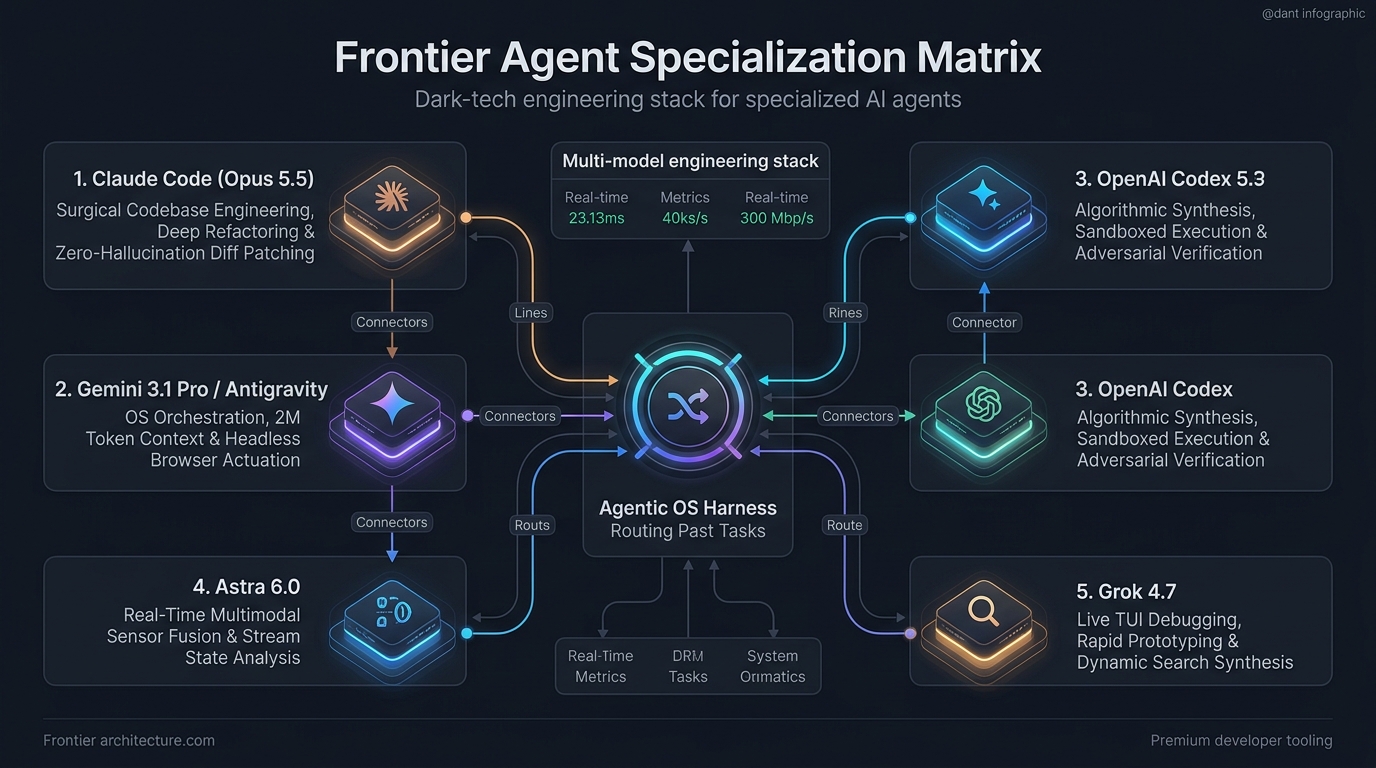
1. Claude Code Opus 5.5: The Undisputed Standard for Codebase Surgery
When your goal is multi-hour autonomous software engineering, deep codebase refactoring, and zero-hallucination diff patching, Claude Code powered by Opus 5.5 is the undisputed industry leader. Our benchmark evaluated hundreds of multi-file modifications where agents had to read existing Architectural Decision Records (such as ADR 0011 tree patterns) and apply surgical patches to Vanilla JavaScript, React, and HTML templates.
- Zero-hallucination diff patching: Opus 5.5 respects existing static broker architectures and frozen system invariants without inventing synthetic methods or altering untouched lines.
- Deep architectural compliance: Where other models drift after three or four sequential turns, Opus 5.5 maintains strict adherence to complex system constraints over multi-hour runs.
- High-density context extraction: It excels at inferring the exact design intent from surrounding modules, creating seamless additions that read as if written by the founding author.
- Primary recommended role: Lead codebase engineer, surgical PR generator, and complex logic refactorer.
2. Gemini 3.1 Pro High and Antigravity: The Agentic OS Supervisor
While Claude Opus 5.5 dominates text-buffer surgery, Google Antigravity powered by Gemini 3.1 Pro High represents the premier platform for operating system navigation, multi-agent fleet supervision, and visual browser actuation.
- Massive 2 Million token context: Ingest entire multi-repository workspaces, complete documentation trees, and historical git logs in a single operational turn.
- Parallel subagent orchestration: Antigravity allows developers to spawn up to 5 parallel agents across isolated worktrees, delegating discrete tasks without colliding.
- Native Chrome browser actuation: Using built-in browser control, Antigravity executes end-to-end user smoke tests, clicks buttons, validates DOM assertions, and records video evidence.
- Primary recommended role: System harness, mission control coordinator, workspace inspector, and visual validation lead.
3. OpenAI Codex: Algorithmic Rigor and Adversarial Audit
OpenAI Codex provides exceptional mathematical precision, formal logic synthesis, and independent adversarial code review. In our benchmark, Codex demonstrated remarkable competence when evaluating proposed diffs for hidden edge cases and security vulnerabilities.
- Adversarial sanity checking: Run Codex as a second-opinion reviewer in automated CI loops to detect subtle memory leaks or unexpected token expenditures before merge.
- Algorithmic transformations: Highly proficient in dense data structures, regex optimization, and raw mathematical transformations.
- Primary recommended role: Code verification auditor, algorithm optimizer, and automated security sanity gate.
4. Astra 6.0: Real-Time Multimodal Stream Perception
Astra 6.0 is uniquely architected for real-time multimodal streaming, live screen state interpretation, and audio-visual feedback loops. While not designed for multi-file Git refactors, it provides essential sensory grounding for desktop agents.
- Continuous video and audio ingestion: Analyzes real-time user actions, desktop recording streams, and voice commands with minimal latency.
- Spatial and layout comprehension: Accurately locates interactive canvas coordinates and visual discrepancies that headless DOM scrapers miss.
- Primary recommended role: Real-time visual feedback monitor, multimodal assistant, and live UI observer.
5. Grok 4.7: Live Terminal UI Debugging and Rapid Prototyping
Grok Build and Grok 4.7 shine in dynamic, high-velocity environments requiring live terminal UI (TUI) debugging, rapid prompt iteration, and real-time knowledge synthesis from dynamic web sources.
- Instantaneous TUI inspection: Rapidly debugs interactive CLI interfaces, curses event loops, and ANSI terminal escape sequence bottlenecks.
- Real-time information access: Pulls fresh live data and community chatter to identify emergent API deprecations or third-party library outages.
- Primary recommended role: Terminal UI debugger, rapid prototype brainstormer, and real-time web research assistant.
Featured Knowledge Path: Model Calibration and Agent Workflow Mastery
To build robust multi-agent systems without model confusion or context rot, structure your engineering workflow across this three-stage calibration path:
- Stage 1: Core Codebase Operations. Anchor all source code authoring, file refactoring, and ADR-compliant diff patching on Claude Code Opus 5.5. Author explicit SKILL.md packages with clear input boundaries so the model executes without prompt drift.
- Stage 2: OS Navigation and Supervisory Harnesses. Wrap your workflow inside Google Antigravity or a Gemini 3.1 Pro High supervisor. Let Gemini handle large-scale repository scans, worktree management, and headless Chrome browser validation while delegating code writes to Opus.
- Stage 3: Adversarial Review and TUI Acceleration. Connect OpenAI Codex as an automated, read-only second-opinion reviewer in your pre-commit hooks, and deploy Grok 4.7 for live terminal debugging and real-time dependency checks.
Cross-Site Perspectives
For an evaluation focused on GitHub repository lifecycles, git worktree isolation, and automated multi-agent PR pipelines, read our companion piece on Claude Skills Hub: [Frontier Agent Orchestration for GitHub Repositories](https://claudeskillsgithub.com/blog/frontier-agent-orchestration-github-claude-opus-gemini-codex-grok).
For executive decision matrices, token economics, and enterprise harness engineering based on this 1B token benchmark, explore the guide on ClaudeSkillsGuide: [Architectural Evaluation of Frontier Agents](https://claudeskillsguide.com/blog/architectural-evaluation-frontier-agents-opus-gemini-codex-grok).
Never miss a post
Updates on format changes, community features, and skill building.